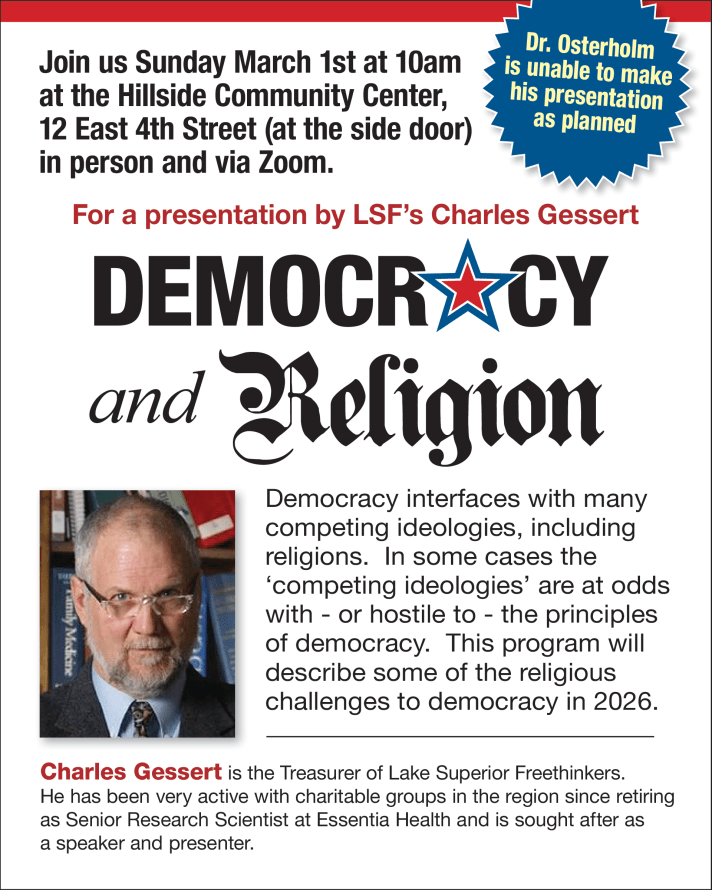
Sunday Mar. 1. at 10:00 at One Roof’s Central Hillside Community Center at 12 East 4th Street in Duluth (coffee / chat at 9:30). Zoom link
LSF’s Dr. Charles Gessert will present.
“Democracy interfaces with many competing ideologies, including religions. In some cases the ‘competing ideologies’ are at odds with – or hostile to – the principles of democracy. This program will describe some of the religious challenges to democracy in 2026.”
CANCELED Sunday Mar. 1. at 10:00 at One Roof’s Central Hillside Community Center at 12 East 4th Street in Duluth (coffee / chat at 9:30). Zoom link
Dr. Osterholm is Regents Professor, McKnight Presidential Endowed Chair in Public Heath, the director of the Center for Infectious Disease Research and Policy (CIDRAP), Distinguished Teaching Professor in the Division of Environmental Health Sciences, School of Public Health, a professor in the Technological Leadership Institute, College of Science and Engineering, and an adjunct professor in the Medical School, all at the University of Minnesota. He is also a member of the National Academy of Medicine (NAM) and the Council of Foreign Relations. In June 2005 Dr. Osterholm was appointed by Michael Leavitt, Secretary of the Department of Health and Human Services (HHS), to the newly established National Science Advisory Board on Biosecurity. In July 2008, he was named to the University of Minnesota Academic Health Center, Aos Academy of Excellence in Health Research. In October 2008, he was appointed to the World Economic Forum Working Group on Pandemics.
Expertise
An internationally recognized expert in infectious disease epidemiology. Disease Surveillance, Epidemiology, Health Communications, Health Communications: Social Media, Infectious Disease, Infectious Disease: Foodborne, Infectious Disease: HIV / AIDS, Infectious Disease: Influenza, Infectious Disease: STDs, Policy / Politics, Public Health Preparedness, Vaccines.
Awards and Recognition
In addition to being awarded a university Regents Professorship in 2015, Dr. Osterholm is also a McKnight Presidential Endowed Chair in Public Health. In addition, Dr. Osterholm has received numerous honors for his work, including an honorary doctorate from Luther College; the Pump Handle Award, CSTE; the Charles C, Shepard Science Award, CDC; the Harvey W. Wiley Medal, FDA; the Squibb Award, IDSA; Distinguished University Teaching Professor, Environmental Health Sciences, School of Public Health, UNI; and the Wade Hampton Frost Leadership Award, American Public Health Association. He also has been the recipient of six major research awards from the NIH and the CDC.
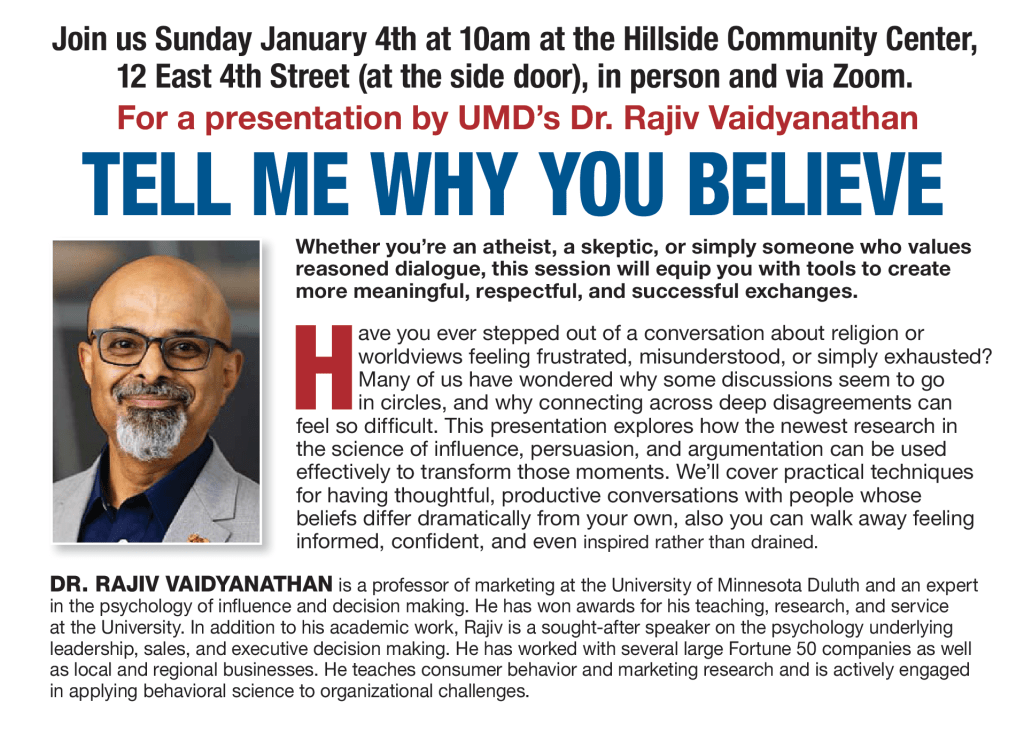
Sunday Jan. 4. at 10:00 at One Roof’s Central Hillside Community Center at 12 East 4th Street in Duluth (coffee / chat at 9:30). Zoom link
Whether you’re an atheist, a skeptic, or simply someone who values reasoned dialogue, LSF’s January speaker will equip you with tools to create more meaningful, respectful, and successful exchanges.
Have you ever stepped out of a conversation about religion or world-views feeling frustrated, misunderstood, or simply exhausted? Many of us have wondered why some discussions seem to go in circles, and why connecting across deep disagreements can feel so difficult. This presentation explores how the newest research in the science of influence, persuasion, and argumentation can be used effectively to transform those moments. We’ll cover practical techniques for having thoughtful, productive conversations with people whose beliefs differ dramatically from your own, so you can walk away feeling informed, confident, and even inspired rather than drained.
DR. RAJIV VAIDYANATHAN is a professor of marketing at the University of Minnesota Duluth and an expert in the psychology of influence and decision making. He has won awards for his teaching, research, and service at the University. In addition to his academic work, Rajiv is a sought-after speaker on the psychology underlying leadership, sales, and executive decision making. He has worked with several large Fortune 50 companies as well as local and regional businesses. He teaches consumer behavior and marketing research and is actively engaged in applying behavioral science to organizational challenges.
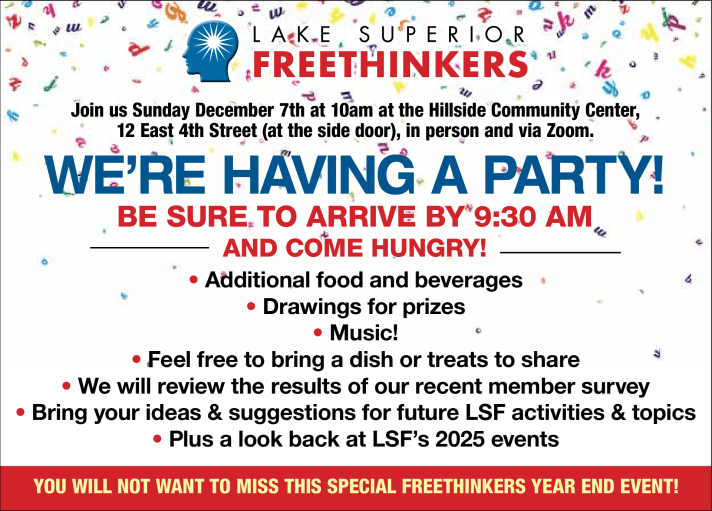
Join us Sunday December 7th at 9:30am at the Hillside Community Center, 12 East 4th Street (at the side door), in person and via Zoom for an LSF Party and LSF review.
WE’RE HAVING A PARTY! BE SURE TO ARRIVE BY 9:30 AM AND COME HUNGRY!
Additional food and beverages
Drawings for prizes
Music!
Feel free to bring a dish or treats to share
We will review the results of our recent member survey
Bring your ideas & suggestions for future LSF activities & topics
Plus a look back at LSF’s 2025 events You will not want to miss this special Freethinkers year end event!
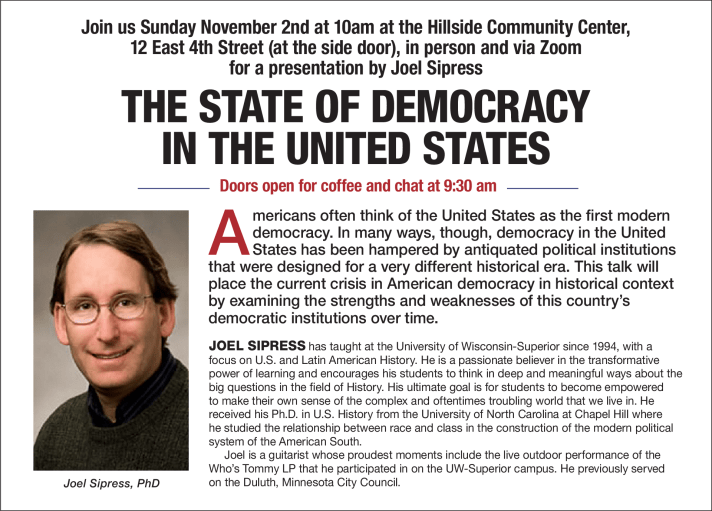
November 2nd’s First Sunday meeting brings Dr. Joel Sipress from UWS to LSF.
Join us Sunday November 2nd at 10am at the Hillside Community Center, 12 East 4th Street (at the side door), in person and via Zoom for a presentation by Joel Sipress
THE STATE OF DEMOCRACY IN THE UNITED STATES Doors open for coffee and chat at 9:30 am Americans often think of the United States as the first modern democracy. In many ways, though, democracy in the United States has been hampered by antiquated political institutions that were designed for a very different historical era. This talk will place the current crisis in American democracy in historical context by examining the strengths and weaknesses of this country’s democratic institutions over time.
JOEL SIPRESS has taught at the University of Wisconsin-Superior since 1994, with a focus on U.S. and Latin American History. He is a passionate believer in the transformative power of learning and encourages his students to think in deep and meaningful ways about the big questions in the field of History. His ultimate goal is for students to become empowered to make their own sense of the complex and oftentimes troubling world that we live in. He received his Ph.D. in U.S. History from the University of North Carolina at Chapel Hill where he studied the relationship between race and class in the construction of the modern political system of the American South.
Joel is a guitarist whose proudest moments include the live outdoor performance of the Who’s Tommy LP that he participated in on the UW-Superior campus. He previously served on the Duluth, Minnesota City Council.

 Lake Superior Freethinkers